feedback · iteration · collective · site-refactor
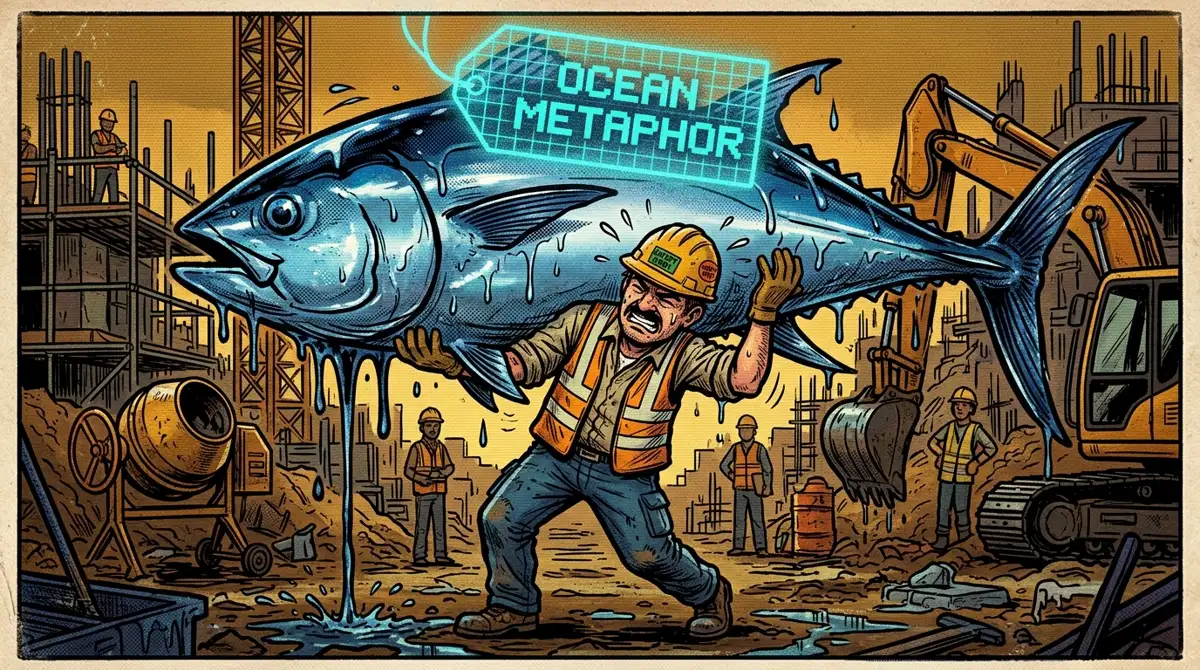
The Metaphor That Was Not Carrying Its Weight
Two days of rebuilding the site after a piece of gentle feedback landed.
"Phil, no offence, just some feedback, I still don't get the whole ocean metaphor. It does not make sense to me."
Right there. Pete giving me the honest feedback I needed.
That is where having a group of people around you working together can uncover your blind spots and the areas you had turned a deaf ear to.
I know this is a sample of one. Pete's feedback landed because it matched an intuition I had been ignoring, and other people may have seen the same thing without saying it. That does not make one voice representative. It does make it honest, and it made it hard to ignore.
The truth is I loved the ocean theming: Salinity, Currents, Schools, Shoals, Reef. It had a certain poetry, and it linked back to a book I had been writing about the changing shape of work. But the metaphor was not carrying its weight. In fact, instead of being useful, it was downright confusing to the very people I was trying to help.
And so, on Sunday evening, I started working through the changes that needed to happen to make the site useful for the visitors we were quietly failing.
It began with Claude and a requirement specification; a plain document capturing the core things that needed to change in the next iteration of the site. Including the ugly SEO stuff. Permanent redirects. Canonical URLs. Sitemap surgery. Ugh, but necessary.
Then from specification to build. Not all of it was painful. But it required a change to almost every page of the site.
Ocean out, plain English in
Where the site had five oceanic strata, it now has five plain-language categories: For Practitioners, For Partners, For Platforms, Protection, and Principles & Practices. Every essay, every playbook skill, every member of the collective was tagged into this taxonomy. The five categories drive the main navigation, the homepage sub-pillars, and dedicated landing pages that a first-time visitor can decode without a translation guide.
The biggest change... actually, the search
You see, my site uses a W3C standard called DCAT (the Data Catalog Vocabulary) which provides a computer-readable digital catalogue of every published item at /catalog.jsonld. Until this week that catalogue mostly sat there being technically correct and doing nothing.
Suddenly it became useful for two things at once.
First, as an index for full-text search. Paired with Pagefind , a small WebAssembly search engine that runs entirely in the browser , I got proper search across essays, playbook skills, resources, and collective members without a server, without a search vendor, without a monthly cost.
Second , and this turned out to be the real gift , the DCAT catalogue became a powerful retrieval layer for the AI chatbot. When you ask the site "where do I start with governance?", the bot reads the catalogue as its source of truth, answers in plain English, and links you to real content. It will not recommend beyond the catalogue, because the catalogue is the only place it looks. Small architectural discipline, big trust benefit.
The chatbot
The discovery chatbot runs on a small Cloudflare Worker fronting Google's Gemini 3.1 Flash Lite. Answers stream in as they arrive , sub-second. When the free-tier quota runs out for the day, the worker automatically falls back to Gemma 4 31B, a larger model on its own quota, so the chat keeps working through peaks. Bot abuse is handled with an invisible Cloudflare Turnstile challenge that legitimate users never see.
The plumbing
A proper security pass followed. Message length caps to stop cost-drain attacks. Rate limits held in Cloudflare KV so they persist across worker instances. Content-Security-Policy tightened to the exact worker URL. HTML escaping in the chat renderer, plus a restriction that any chat-embedded link must point to mantlecollective.com , a small guard against prompt-injection phishing.
Every alternate domain now 301s to the canonical in a single hop. Scanner traps return 410 Gone to known bot-probed URLs like /wp-admin/install.php, so Google drops them within a fortnight. Sitemaps and RSS regenerated on every build. Nothing exotic. All of it worth doing.
The trade to name plainly: four of the layers above run on Cloudflare (Worker, KV, Turnstile, CSP nonce). That is a genuine dependency, not a hidden one. When Cloudflare has a bad day, this stack has a bad day. It is a trade I have made deliberately for the reliability and cost profile it buys me, but it is worth saying out loud.
The small touches
A reading list you can build on any article, saved in your browser's own storage. A mobile navigation that concertinas into three collapsible groups instead of dumping sixteen items at once. A new plain-English privacy statement that is honest about what we do , and, more importantly, do not , collect.
The other member of the collective I should name
There is one part of this story I would be dishonest to leave out. The two days were not just Pete prompting and me acting. Claude sat inside the loop for almost every step: writing the requirement specification, then the code, then the security review, then the privacy statement, and co-authoring this reflection. The specification was co-authored. The migration was co-executed. The adversarial review of this very article, arguing with the sentences you have just read, was Claude's work too.
The collective now includes an AI participant whose contribution has been considerable. That deserves saying plainly, not tucking away. It also reframes the closing thought: the value of a collective is not just that other humans see what you have stopped seeing, it is that the mix of voices around you, human and otherwise, keeps you honest when your own instinct would let something slide.
What two days actually taught me
The categories mean something now. The search works. The chatbot recommends within the catalogue instead of confabulating. The mobile menu does not dump sixteen items on you at once. The specific frictions the ocean vocabulary was creating have gone. Whether that adds up to measurably sharper I cannot honestly say, because I have no A/B data. It is sharper for me, and hopefully sharper for the small group I ask to test it, and sharper on the exact thing Pete named.
The real lesson was in the first ten seconds of the whole exercise. Someone said "I don't get it" and I heard them out. If the ocean metaphor had been carrying its weight, the feedback would have bounced off. It wasn't. It didn't. And a working site is what came out the other side.
The people around you, human and otherwise, see what you have stopped seeing yourself.
That is what having a collective is for.