learning · human-centred-design · governance
Fireside Chat: What Happens to Learning When AI Accelerates Everything
An honest conversation with ADA educators about the human side of AI adoption—what we got right, what we nearly missed, and why oversight matters.
I sat down recently with a group of educators from ada for a fireside conversation on AI adoption.
The big takeaway, organisations like ADA are being highly proactive in preparing for what comes next. They are recognising that the apprentices that are coming through now need equipping with the right thinking skills to adapt to a rapidly changing environment, with a specific focus on thinking skills related to digital delivery.
The Acceleration Trap
An AI agent can do the work of a 3 person team working for a week without breaking a sweat. That's real. And for some organisations, it's a genuine competitive advantage.
Now speed looks like a win until you realise nobody's thinking about what's being accelerated. Or what's being lost.
The ada staff team noted that rising costs and the risk that venture-backed companies might eventually reduce token availability or raise prices could cause a supply affordability issue for organisations. They were spot on. This is a real challenge that is going to raise its head, a lot of activity at the moment is subsidised and it is likely that as cutting edge models are released and older models deprecated, that we will see and strong increase in the cost of tokens and AI coding environments.
They also noted that poor or un-managed "vibe-coding" coding practices could leave organisations with security exposure. Specifically making use of unsecure libraries and source code that exposed companies to supply chain and owasp type risks. In some ways the concern is founded, but with the correct agentic workflows, orchestration and CI/CD practices a lot of these concerns can be mitigated.
Building in Agentic security and Red Team reviews into the development process also means there is a level of assurance and auditability. This does however come at a cost. Alongside this you still need a SME to be in the development loop to ensure coding practices are adhered to and that a human is part of the code review process.
The Quality Problem Nobody Talks About
The team raised the most common issue: "AI generates fast noise." AI without guard rails behaves the same as a human who does not know better. It just does it quicker than anyone can process. The key here is putting in place the right guardrails. The mantlecollective.com is working to pull some of these playbooks and skills together to help define healthy processes for AI usage. AI that enhances human agency.
Good guardrails have a cost. Both in financial terms (tokens) and human terms (governance and assurance). So when considering the cost, people should consider the total cost of ownership from system design, build, operation and obsolescence. Build it with the right guardrails and it should save you money, without it is going to cost you in the long run.
A note on the McKinsey report on AI from 2025 is that while 54% is technically automatable (AI & Robotics), there is a dependence on it having the correct quality standards and governance wired in, and a level of organisational maturity to deliver.
Governance Has to Come First
We got on to speaking about governance and the importance of it within organisations adopting AI. The natural evolution of that was you cannot evaluate what you cannot measure but more importantly, you cant modernise a process that is not mature. For a process to be automated you need
- Documented playbooks or flowcharts. You have to know how the process works.
- A designated process owner. Someone accountable for quality and outcomes, someone who knows what's being measured.
- Continuous monitoring. You're actually measuring whether it's working.
It's easy to hear this as a checklist for automation decisions. But it's not. It's governance.
Before you automate anything, whether with AI or not, you need these three things. Otherwise, you don't have visibility. And if a process is already sloppy, automation doesn't fix it. It just makes you sloppy faster.
Organisations that are already cutting corners with processes and security don't need better AI governance. They need governance, and they need it before they touch AI. Otherwise they're just compounding existing problems at scale.
That is not to say that you cannot build replacement processes iteratively. This is still a viable approach.
A Question That is Close to My Heart.
Geoff Stevenson raised a question that is close to my heart: what happens to apprentices when AI automates everything?
if AI eliminates all the tedious parts of the work, where does the apprentice build up their Subject Matter Expert (SME) muscle? Where does the instinct develop, the ability to know something's wrong even when you can't articulate why?
This is the obscured issue businesses are going to face in around 5 years. Expertise comes from exposure to difficult problems, from making mistakes under pressure, from reflecting on what went wrong. Friction builds judgement.
The McKinsey data shows that the roles growing fastest are business analysis, machine learning, teaching, process improvement, people management. All require judgement. All require practice. You can't learn them in the abstract. You have to do them, fail, reflect, improve.
So the simple tension that is going to exist for organisations is intentionally building the future SME while optimising for cost and efficiency.
The Burnout Nobody's Talking About
Speed burns people out.
When you can compress a week's worth of work into a day, the temptation is to do exactly that. Every day. The tools make it possible, so the culture makes it expected. Before you realise what's happened, people are working until midnight every night, pushing hard constantly, and there's no recovery. I experience this directly in my current practice and I have to be really careful to control my urge to do one last thing.
I was speaking to one of my contacts in healthcare who is an avid hobbyist developer and he described it as having a super power. "I can do incredible things, so I will"
We need to educate people to prepare them for this. We do not want to end up like the genie in the lamp "INCREDIBLE COSMIC POWER, itty bitty living space!"
We need human governance that protects the organisations most value asset. People.
What Crystallised
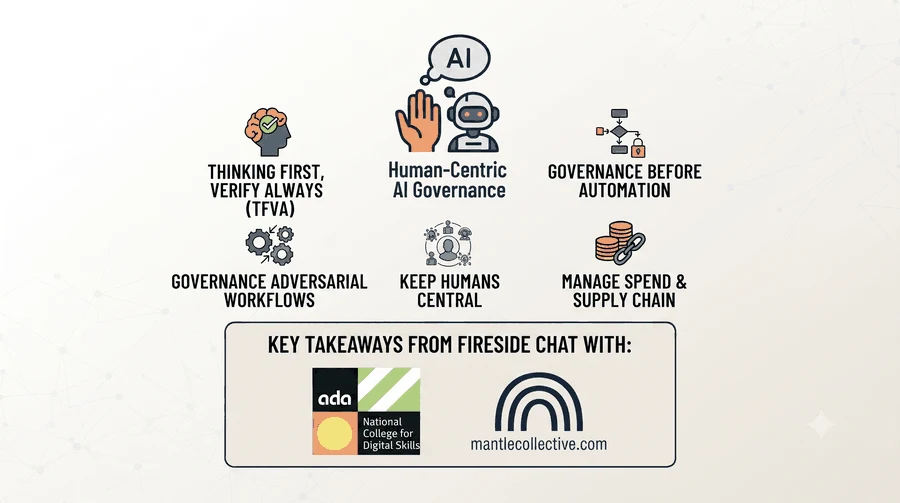
Point that I think were key across the conversation:
- Thinking comes first, verification is always (TFVA). If you're going to use AI, know what problem you're solving. And don't trust the output. Check it hard.
- Build adversarial workflows. Make it structural. Have someone actively challenge what AI produces. That's where human judgement becomes irreplaceable.
- Governance before automation. You need documented processes, clear accountability, and measurement. Without those, you just get faster problems.
- Keep humans central. In learning. In decision-making. In quality control. In the thinking itself.
- Govern your spend and supply chain. Monitor who has access to which tools, what they cost, what they're ingesting. AI amplifies whatever you already do. Good or bad.
Why This Matters
Ada like most educational institutes is placed incredibly well to support the next generation of workers with skills that ensure they can navigate the AI workplace. Don't avoid the tooling and the ecology that comes with the changes in the way we work, but put in place adaption techniques to ensure that human workers can succeed and overcome to establish themselves as the next SME's.
Thanks to Geoff and the team from ada for their time and willingness to chat.